AVA is designed to determine the best submission grappler.
The structure of the rules and format reflects that. Round robin format means every athlete competes against everyone in their group.
Not all wins are equal. A submission in regulation is worth the most points and the athlete with the most points wins the division. How you win matters more than how many times you win.
The pure submission grappler is the one who finishes the most, the fastest, compared to everyone.
Matches are won by submission during regulation time or in overtime by submission, fastest escape, referee decision, walkover or by opponent disqualification.
Note: A submission is when your opponent clearly taps (at least twice with their hand(s) or foot/feet) or gives a verbal tap (saying “tap or loudly yelling in discomfort). The referee can also stop the match early to prevent serious injury. If you release a submission because you believe your opponent tapped but the referee did not see or confirm it, the tap may not count. For this reason, competitors are advised to maintain the hold until the referee officially stops the match.
The AVA round robin points structure is designed to favor submission in regulation. Each match outcome awards points to the winner. When the division is finished, the competitor with the most points wins.
Submission in Regulation: 4 Points
Submission in Overtime: 2 Points
Fastest Escape (overtime): 1 Point
Decision: Awarded 1 Point
Walkover: Awarded 2 Points
Disqualification: 3 Points
These match points apply only during round robin stages (groups of up to 5 competitors). When a division has 6 or more competitors, it is split into groups. The top competitor from each group advances to a final bracket (see pool formation and elimination rounds for more detail in Brackets section), where match wins decide the outcome — points are not used.
For details on group formation, see the Brackets section.

In the event of a tie, the tie is broken using the following criteria in order of priority:
Head-to-head: Who won when they fought each other.
Sum of all match points: Who earned more total points across all matches in their group.
Number of wins by submission: Who had more wins by submission.
Fastest submission (in seconds): Who got their fastest submission in less time.
Shortest total time in won matches: Who spent the least total time in the matches they won.
Number of wins by decision: Who had more wins by decision.
Number of wins by walkover: Who had more wins by walkover.
Number of wins by disqualification: Who had more wins by disqualification.
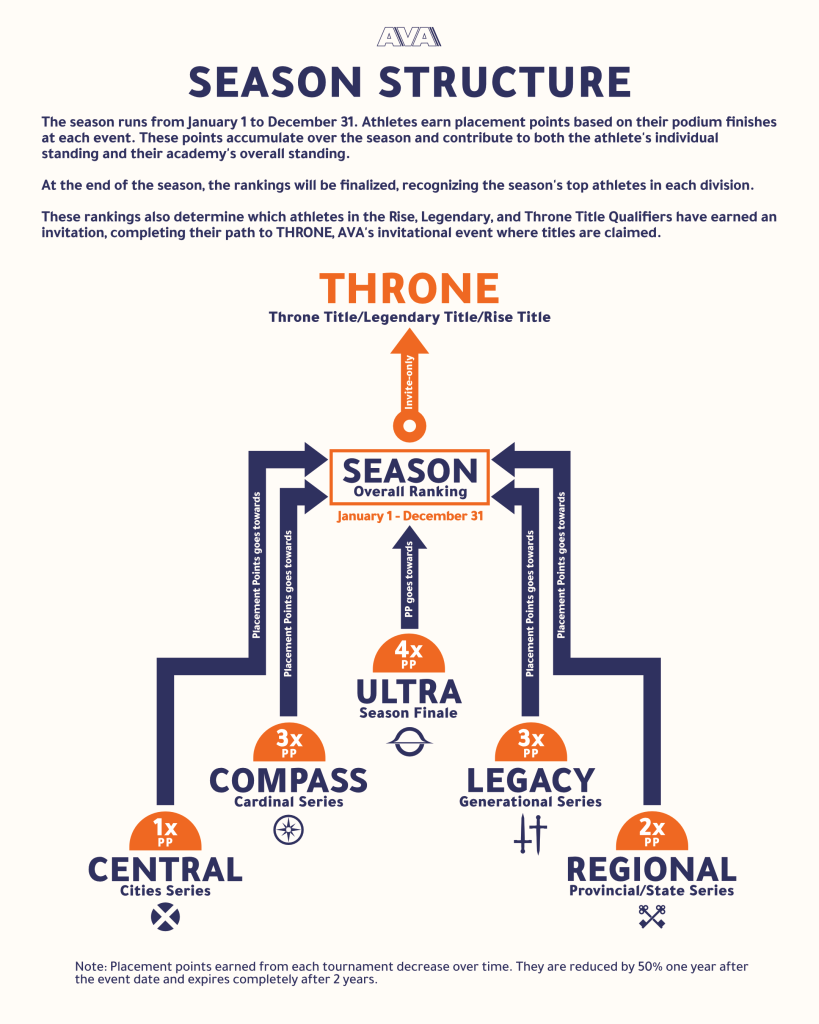
When athletes place on the podium, their team earns points.
Gold — 10 points
Silver — 4 points
Bronze — 2 points
These points go toward your team’s standings at the tournament (Overall Team, Overall Adults, and Overall Youth) and are also added to the Season Team Rankings (Overall Team, Overall Adults, and Overall Youth).
Some tournaments are worth more than others. The points you earn are multiplied based on the event level:
Ultra — 4x
Legacy Series (Legends/Origins) — 3x
Compass Series (Western/Eastern) — 3x
Regional Series (Provincial/State) — 2x
Central Series (City) — 1x
Definitions:
CHOKES & STRANGLES: Techniques that restrict blood flow or airway through the neck.
UPPER BODY JOINT LOCKS: Techniques that attack joints above the waist.
LOWER BODY JOINT LOCKS: Techniques that attack joints below the waist.
COMPRESSION LOCKS: Techniques that squeeze or compress the muscle against bone.
CERVICAL LOCKS: Techniques that attack the neck or spine.
TAKEDOWNS & HIGH-IMPACT MOVEMENTS: Techniques that bring an opponent from standing to the ground or entries that carry elevated risk of injury.

If regulation ends without a submission, the match goes to overtime.
Each competitor has one round of 1 minute to attack. A coin toss decides who attacks first.
The referee will ask the attacker “A or B.” A is Arm-Trap, B is Back. The attacker may choose either side for both positions.
STARTING POSITIONS
Arm-Trap: An elbow-to-elbow hooked-arm trap position, with the other hand posted head-side on the mat. The attacker’s legs must be in the fork position (not crossed). The defender must be in the figure-four defense position with the far hand under the attacker’s leg that is over their face. Bodies must be perpendicular.
The Back: The attacker sits upright with a seatbelt grip at the lower sternum. The defender’s hands must be on top of the attacker’s seatbelt.
HOW OVERTIME IS DECIDED
The competitor with the fastest submission wins. If neither competitor submits, the competitor with the fastest escape wins. A submission always takes precedence over an escape. If no one submits or escapes, the referee decides the round. The referee’s decision is final.
LIVE POSITIONS
Live positions are positions that can flow together without the match being stopped. Any submission position is also considered live.
12 and under: Arm-Trap, Back, Mount, Quarter Mount and Side Control.
13 and over — Arm-Trap, Back, Mount, Quarter Mount, Side Control and Truck.
16-17 years White, Blue Belt and Purple belt: Arm-Trap, Back, Mount, Quarter Mount, Side Control, and Truck.
18+ White, Blue, Purple belt and above, Back, Spider Web, Mount, Quarter Mount, Side Control, Truck, 411.
Side Control includes its variations such as North-South, Knee-on-Belly, Scarf Hold, etc.
ESCAPE
An escape is when the competitor gets completely free from any live position or submission attempt. When the referee sees an escape, they will count 3 seconds to confirm the position is clear before stopping the round.
An escape is recognized when the competitor establishes Closed Guard, Half Guard (or variations), Open Guard (or variations), a top position inside the attacker’s guard, or standing, with no submission threat.
PENALTY (3 PENALTIES = MATCH DQ)
Stalling (Regulation): Not trying to make progress. The referee will call the athlete’s corner color (“Orange,” “Blue,” or “Orange & Blue”) and start a 10-second countdown in their head. If no action is taken, a penalty is issued.
Stalling (Overtime): Holding a position without trying to submit the opponent. The referee will call the attacker’s corner color and start a 5-second countdown in their head. If no action is taken, the round stops and an escape is awarded to the opponent.
Fleeing the match area: Leaving the mat to avoid fighting, or pushing the opponent off the mat. Takedown attempts do not apply.
Disobeying a referee order.
Inserting hands inside underwear: Grabbing the pants at the hip is allowed, but gripping the underwear is not.
Disengaging from combat: Pulling away from the opponent and not returning to fight right away.
Clubbing: Downward clubbing motion with the forearm or hand are allowed. Any clubbing motion from the side that looks like a slap, punch, or hook is a penalty.
No standing in triangle — A competitor cannot stand fully upright when being attacked with a triangle. The referee resets with the attacker on their back and the defender on their knees. A squatted posture is allowed.
MATCH DQ (IMMEDIATE)
Vomiting or secreting bodily fluids: The opponent wins by walkover. This includes nosebleeds. May result in a Division DQ depending on the circumstance.
Fake match: Matches must be real. Staged fights, fixed outcomes, or lack of effort result in both competitors being disqualified.
Causing a penalty during a submission escape: Example: escaping a triangle by placing fingers inside the opponent’s sleeves.
Forcing the opponent into an illegal position: Trying to get the opponent penalized or disqualified on purpose.
Not wearing underwear.
Squeezing or crushing groin.
DIVISION DQ
Striking: This includes slapping, punching, kicking, and head butts.
Gouging: Pressing into any orifice. This includes the eyes, eye socket, ears, nose, mouth, throat, armpit etc.
Biting, fish hooking, gouging, hair pulling: Includes chin in eye socket, thumb in armpit.
Bad hygiene: Nails must be trimmed short. Long hair must be tied up. Hair dye that stains the opponent’s Gi is a DQ. Athletes must be clean and free of strong body odor. Gi and No-Gi attire must be clean and free of odor.
Using slippery substances: Anything that makes the body or Gi slippery.
Using sticky substances: Anything that makes the body or Gi sticky.
EVENT DQ
Hostile behavior: Poor sportsmanship including foul language, disrespectful gestures, or violence.
Infectious skin condition:— Visible skin gashes or sores will be referred to the medical area. The medical team decides if the athlete can compete.
All overtime rounds are 1 minute per competitor.
Ages 4–6: 2 minutes
Ages 7–15: 3 minutes
Ages 16–17 (White/Blue/Purple): 4 minutes
Adults 18+ (White/Blue): 4 minutes
Adults 18+ (Purple/Brown/Black & Throne Qualifiers): 5 minutes
Throne Title Matches: Round 1: 5 minutes, Round 2: 4 minutes
If a competitor has consecutive matches, they are given a 5-minute rest period between bouts.
2 Athletes: Best of three matches
3-5 Athletes: Round Robin format. Everyone fights everyone.
6-10 Athletes: Split into 2 groups (maximum 5 per group). Everyone in the group fights everyone. The top 2 from each group advance to a single-elimination bracket with a bronze match.
11-15 Athletes: Three pools will result in one elimination bracket. One athlete from each group qualifies for the elimination round (Single-elimination – Shortcut Bronze).
16-20 Athletes: Four pools will result in one elimination bracket. One athlete from each group qualifies for the elimination round (Single-elimination – Bronze Match).
21 and up: Several pools (maxing 5 athletes per pool) will result in one elimination bracket. One athlete from each group qualifies for the elimination round (Single-elimination – Bronze Match).
DIVISIONS
AVA offers Gi and No-Gi divisions across all categories. Every division follows the same format and scoring system. What changes between divisions is the ruleset, which techniques are allowed depends on age and belt level.
Rulesets by Age and Belt
Ages 4–12: Youth ruleset.
Ages 13–15: Teen ruleset.
Ages 16–17 and 18+ White Belt: Same ruleset.
18+ Blue Belt: Blue belt ruleset.
18+ Purple, Brown, and Black Belt: Advanced ruleset.
Throne Title Qualifiers: Throne ruleset.
Refer to the Technical Rules chart for the specific techniques allowed in each ruleset.
When a division includes competitors of different belt levels, the ruleset follows the first listed belt on the scoreboard.
Beginner Divisions
6-Months and Under (All Ages): For athletes in their first six months of training with no prior experience in any grappling-based sport (wrestling, judo, sambo, etc.). Matched by weight and age. Separated by gender.
Standard Divisions
Youth (Ages 4–15): Matched by age group, weight class, and experience level. Separated by gender.
Juvenile (Ages 16–17): Matched by belt rank and weight class. Separated by gender. Juvenile athletes may request to compete in Adult divisions. Not eligible for Masters.
Adult (Ages 18+): Matched by belt rank and weight class. Separated by gender.
Masters (Ages 30+): Matched by belt rank, weight class, and age group. Separated by gender. Masters athletes may compete in younger Masters age groups or Adult divisions.
Standard Masters age groups: 30, 40, 50, 60, 70.
At Legends events (Masters-only): 30, 35, 40, 45, 50, 55, 60, 65, 70, 75.
Open / Absolute: Optional open-weight bracket. Divided by rank, belt rank and gender. Available to Juvenile, Adult, and Masters athletes who are registered in their standard division.
Elite Divisions
Elite divisions run alongside standard tournament brackets. They are the qualification pathway for AVA title matches at THRONE.
Throne Title Qualifiers (Adults 18+): Open rank, open weight, separated by gender. The #1 ranked athlete at the end of the season is invited to challenge the reigning Throne Title Holder. Champions receive the official AVA title belt and a cash prize.
Legendary Title Qualifiers (Masters 30, 35, 40, 45, 50, 55, 60, 65, 70, 75): Open rank, open weight, separated by gender. The top-ranked athletes compete for the Legendary Title at THRONE. Beginning in 2028, the reigning champion defends annually.
Rise Title Qualifiers (Youth 4–17): Open rank, open age, matched by weight only. Separated by gender. The #1 and #2 ranked athletes compete for the Rise Title at THRONE. Titles are earned fresh each year, they are not defended.
Any athlete found misrepresenting their experience level in any division may be disqualified, rebracketed, or banned from future AVA events.
All divisions use the same weight classes. Competitors must weigh in at or under the limit for their class.
21 kg (under 46.3 lbs)
24 kg (under 52.9 lbs)
28 kg (under 61.7 lbs)
32 kg (under 70.5 lbs)
36 kg (under 79.4 lbs)
40 kg (under 88.2 lbs)
45 kg (under 99.2 lbs)
50 kg (under 110 lbs)
55 kg (under 121.3 lbs)
60 kg (under 132.3 lbs)
65 kg (under 143.3 lbs)
70 kg (under 154.3 lbs)
76 kg (under 167.6 lbs)
83 kg (under 183 lbs)
91 kg (under 200.6 lbs)
100 kg (under 220.5 lbs)
+100 kg (over 220.5 lbs)
Youth Belts (Ages 4–15)
Promotion is based on age and skill. Coach discretion applies.
White Belt: Ages 4–15
Grey/White, Grey, Grey/Black: Ages 4–15
Yellow/White, Yellow, Yellow/Black: Ages 7–15
Orange/White, Orange, Orange/Black: Ages 10–15
Green/White, Green, Green/Black: Ages 13–15
Juvenile Belts (Ages 16–17)
Promotion is at the discretion of the athlete’s coach.
White Belt: Ages 16–17
Blue Belt: Ages 16–17
Purple Belt: Ages 16–17
Adult Belts (Ages 18+)
Promotion is at the discretion of the athlete’s coach based on progress, skill, and readiness.
White Belt: Ages 18+
Blue Belt: Ages 18+ (minimum 2 years at White)
Purple Belt: Ages 18+ (minimum 2 years at Blue)
Brown Belt: Ages 18+ (minimum 1.5 years at Purple)
Black Belt: Ages 19+ (minimum 1 year at Brown)
Anti-Sandbagging
Athletes with significant experience in other grappling or combat sports cannot compete as White Belts. This includes judo black belts, college-level or national-level freestyle or Greco-Roman wrestlers, and amateur or professional MMA fighters.
One competitor wears an orange wristband. The other competitor is blue (no wristband). The referee uses these corner colors to address competitors throughout the match.
Enter: Referee waves both competitors onto the mat.
“Fight!”: Match begins or resumes. Referee raises one hand above their head, then swings it down toward the mat while calling “Fight!”
“Stop!”: Match is paused or stopped. Referee extends both arms out.
“Freeze!”: Competitors must stop in place. Used when the referee needs to reset the position, such as when competitors settle out of bounds. The referee will reposition the competitors and restart the match.
Penalty: Referee raises a fist on the side of the penalized competitor’s corner color.
“Orange Stalling” / “Blue Stalling” / “Orange/Blue Stalling”: Stalling warning. The referee calls the competitor’s corner color out loud and begins a silent countdown in their head (10 seconds in regulation, 5 seconds in overtime). If the competitor takes action, the count stops. If the countdown reaches zero, the referee issues a penalty.
Disqualification: Referee crosses both hands above their head.
Declare Winner:
Referee raises the winning competitor’s hand and loudly announces the outcome to the scorekeeper: “Winner by Submission”, “Winner by Submission in Overtime”, “Winner by Fastest Escape”, “Winner by Decision”, “Winner by DQ”, “Winner by Walkover”
“A or B”: Asked to the attacker at the start of overtime. A is Arm Trap, B is Back.
“3, 2, 1, Fight!”: Overtime round begins. Referee taps both competitors to signal the start.
The referee positions themselves to maintain a clear line of sight for the scorekeeper when possible. When the action requires closer attention, the referee will move in regardless of scorekeeper visibility. The referee also navigates the mat border to stay close to standing competitors and guide them to stay inside the mat.
Out of Bounds, No Submission
When competitors go out of bounds with no submission active and their position settles, the referee calls “Freeze!” and resets the match to the position they were in when the call was made.
Out of Bounds, Submission Active
When a submission is active, the match continues. The referee only stops the match if the competitors interfere with another ongoing match or are about to crash into the scorekeeper table. In both cases, the referee calls “Freeze!” and resets the competitors with the submission still applied.
The referee has the authority to stop a match at any time to protect an athlete’s safety. The level of intervention is based on the athlete’s age.
Ages 4–6
The referee stops the match when the submission is fully locked in and in a finishing position. No pressure is required. The referee does not wait for a tap.
Ages 7–12
The referee stops the match when the submission is fully locked in and in a finishing position. The athlete has 3 seconds to begin a recognizable escape. The countdown is silent. If no escape attempt is made, the referee stops the match.
Ages 13–15
The referee allows 5 seconds once the submission is fully locked in and in a finishing position. The countdown is silent. If no tap or recognizable escape attempt is made, the referee stops the match.
Ages 16–17 and Adults (18+)
Athletes are expected to tap on their own. The referee may intervene at any time if the athlete is in danger, or clearly unable to defend themselves.
The referee asks the attacker “A or B.” A is Arm Trap, B is Back. The attacker chooses their side.
The referee positions both competitors and approves the positions before starting. For the Back position, the referee maintains a knee on the attacker’s back to prevent them from leaning.
Once both competitors are set, the referee taps both competitors and calls “3, 2, 1, Fight!”
When the referee identifies an escape, they count 3 seconds to confirm the position is clear before stopping the round.
Overtime rounds are never redone. A double draw is never called.
When the referee must decide the outcome (overtime with no submission or escape), the decision is based on overall match performance in the following order of priority:
Submission attempts, most important.
Positional dominance.
Defended submissions.
Penalties, least important.
If a competitor does not show up for their match, the referee may skip to another match. If the competitor remains absent after multiple attempts to locate them, the opponent wins by walkover.
Gi Divisions: Competitors must wear a clean BJJ Gi and rashguard. For men, wearing a rashguard is optional.
No-Gi Divisions: Competitors must wear a clean rashguard and grappling shorts with no pockets or zippers, with or without spats. For men, wearing a rashguard or T-shirt is optional.
Clothing with inappropriate language or imagery is not allowed.
Finger and toenails must be trimmed short. Long hair must be securely tied up.
Footwear must be worn up to the match area and in all common areas. Bare feet only on competition mats and warm-up mats.
If an athlete is found to have skin lesions during inspection, they will be directed to the medical area. Athletes must present a medical certificate stating the lesion is not contagious and poses no risk to other competitors.
A professional medical team is available on-site at all AVA events. The medical team has the final authority to decide whether an athlete is fit to compete.
WEIGH-IN PROCEDURES
Competitors can weigh in on event day or the day before, without the Gi. A 1 kg allowance is applied to all divisions to account for home scale differences.
If a competitor does not make weight, they get one more attempt before their division starts. If they still do not make weight, they are disqualified.
For parents and coaches: children’s weight can change quickly due to growth. Monitor their weight daily for two weeks before the event to make sure they are in the right weight class.
SAFE WEIGHT MANAGEMENT
AVA is committed to athlete safety and discourages unsafe weight cutting. Athletes are responsible for managing their weight safely. Coaches should guide athletes in healthy practices. If event staff or medical personnel think an athlete is dangerously dehydrated, they can step in.
Recommended practices:
Plan ahead: Monitor weight well before competition. Avoid last-minute cuts.
Stay hydrated: Maintain consistent hydration throughout training and preparation.
Cut gradually: If weight loss is needed, do it over weeks, not days.
Eat well: Follow a diet that supports training, recovery, and overall health.
Weight cut limits:
Weigh-in within 3 hours of competition: Maximum 1% body weight reduction.
Weigh-in 8+ hours before competition: Maximum 2% body weight reduction.
Weigh-in the day before competition: Maximum 3% body weight reduction.
Prohibited practices:
Severe dehydration through excessive sweating, sauna use, or diuretics.
Extreme caloric restriction leading to energy depletion.
IV rehydration after weigh-in.
Deliberate fluid restriction before weigh-in.
These guidelines ensure that AVA Submission Grappling maintains a safe, fair, and professional competition environment while promoting responsible weight management practices.
Competitors
Competitors must demonstrate respect and sportsmanship, treating opponents, referees, and event officials with dignity at all times.
Inappropriate gestures or behavior directed at anyone, including opponents, coaches, parents, or officials, are strictly prohibited.
Competitors are required to wear clean, appropriate attire specific to their division (Gi or NoGi).
Clothing with offensive language or imagery is not allowed.
Maintaining composure and emotional control is essential. While passion is encouraged, aggressive behavior is unacceptable.
Regardless of match outcomes, competitors should acknowledge their opponents’ efforts with professionalism and humility.
Referees’ decisions must be respected. Any appeals should be directed to officials respectfully and will be addressed accordingly.
Verbal remarks toward referees during matches are prohibited.
Violating the code of conduct may result in disqualification, loss of awards, or further disciplinary actions, including potential bans from future AVA events.
Parents and Spectators
Parents play a supportive role and are expected to encourage effort and a positive attitude in young competitors.
Displays of disrespect or inappropriate gestures toward anyone at the event are unacceptable.
Attire with offensive language or imagery is not permitted.
Parents and spectators must respect the opponents, their families, and their coaches, focusing on the skills demonstrated rather than personal criticism.
Cheering should be positive and avoid behavior that disrupts or interferes with the competition.
Demonstrating fairness and respect by acknowledging both competitors is essential for fostering a positive environment.
Verbal remarks toward referees during matches are prohibited.
Concerns or questions should be communicated directly with tournament organizers or officials in an appropriate manner.
Violations of this code may result in removal from the venue and possible bans from future AVA events.
Coaches
Coaches must model respect and sportsmanship, emphasizing these values to their students and peers.
Any form of inappropriate gesture or behavior toward opponents, coaches, parents, or officials is not allowed.
Coaches are expected to wear appropriate attire free of offensive language or imagery.
A thorough understanding of tournament rules is required, and coaches must ensure their students are equally informed to maintain a safe and fair environment.
Coaches should encourage camaraderie by supporting and acknowledging the efforts of all athletes, including those of opposing teams.
Sportsmanship should guide all actions and interactions. Unsportsmanlike conduct or aggression will not be tolerated.
Verbal remarks toward referees during matches are prohibited.
All concerns should be addressed to tournament organizers or officials in a respectful and professional manner.
Failure to adhere to the code of conduct may result in removal from the venue or additional disciplinary actions, including exclusion from future AVA events.
Athletes with significant experience in other grappling sports are not permitted to compete as white belts. This includes , judo black belts, freestyle or Greco-Roman wrestlers, and both professional and amateur MMA fighters.
Athletes must register and compete based on their biological sex as determined at birth. Violations may result in suspension or a ban from all AVA events.