
The History Behind AVA’s Overtime Rule
September 7, 2026 AVA
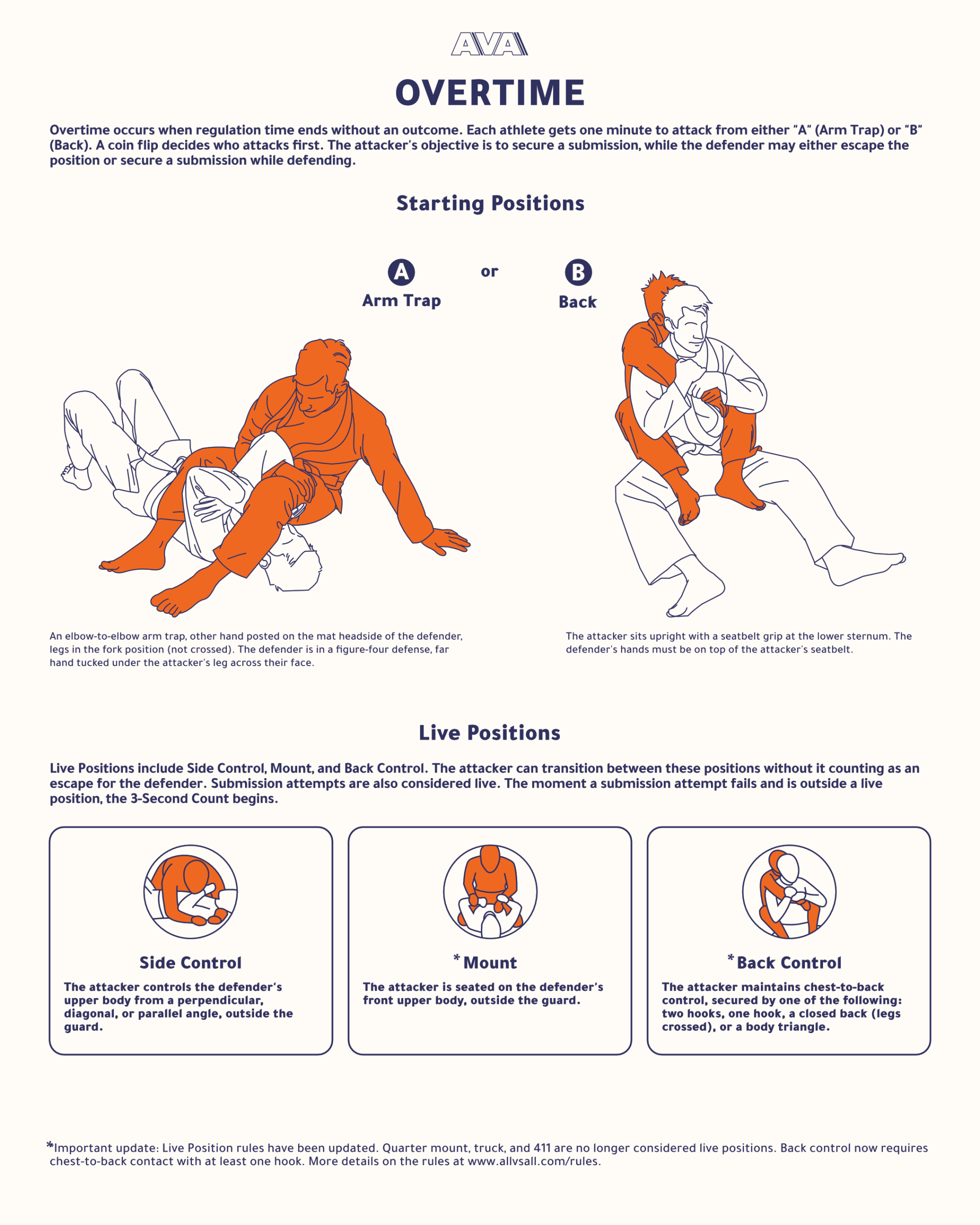
AVA’s rules and overtime exists for one reason — to give a match a real outcome, settled on the mat rather than by a referee. That goal has stayed the same since day one, but how we define an actual escape has changed a lot, and for good reason.
The format started as a version of EBI (Eddie Bravo Invitational) rules, with two changes. Back control was the only starting position, and rounds were one minute each, as they still are today. Under that early format, escaping back control was the only thing that counted as an escape.
By 2024, that definition had proven too narrow, so the Spider Web (later renamed to the Arm Trap) was added as a second starting position and a list of live positions was introduced: mount, side control, back control, truck, and 4/11. From that point on, an escape was judged by whether the defender was actually out of danger, not by whether they landed in one exact spot. Overtime results started to come in with less controversy attached to them.
The summer of 2026 is when the rule truly became its own. The live positions list was narrowed down to 3 positions long recognized as most dominant in the sport: mount, side and back control. A 3 second count was also introduced. If a submission attempt fails and the defender is clear of all 3 live positions when the count ends, the escape is confirmed. Fewer positions and a clear count made the rule sharper than ever and easier for everyone to follow in real time. It’s a rule built on everything that came before it, and it’s about to be put into practice.
EBI made a similar move this past week, updating its own overtime rules so the defender must now recover an accepted guard: closed, butterfly, half, or Z guard, with quarter guard no longer ending the round. It is close to what AVA did in 2024, but one real difference remains — EBI defines the escape by the position the defender reaches, so competitors must land in one of their approved guards. AVA defines the escape by the position the attacker holds, so the competitors do not need to recover any specific guard. They only need to be clear of the live positions for 3 seconds, and that is closer to what a true escape actually is — not a specific position but the absence of control.
AVA’s overtime rules has kept referee decisions consistently under 2% in every tournament, well below most other submission-only rulesets, many of which still heavily rely on decisions when no submission occurs. EBI’s overtime update suggests the submission-only space is moving in a direction that sets a stronger standard overall.
Full AVA overtime rules are available in the AVA Official Rulebook at www.allvsall.com/rules.